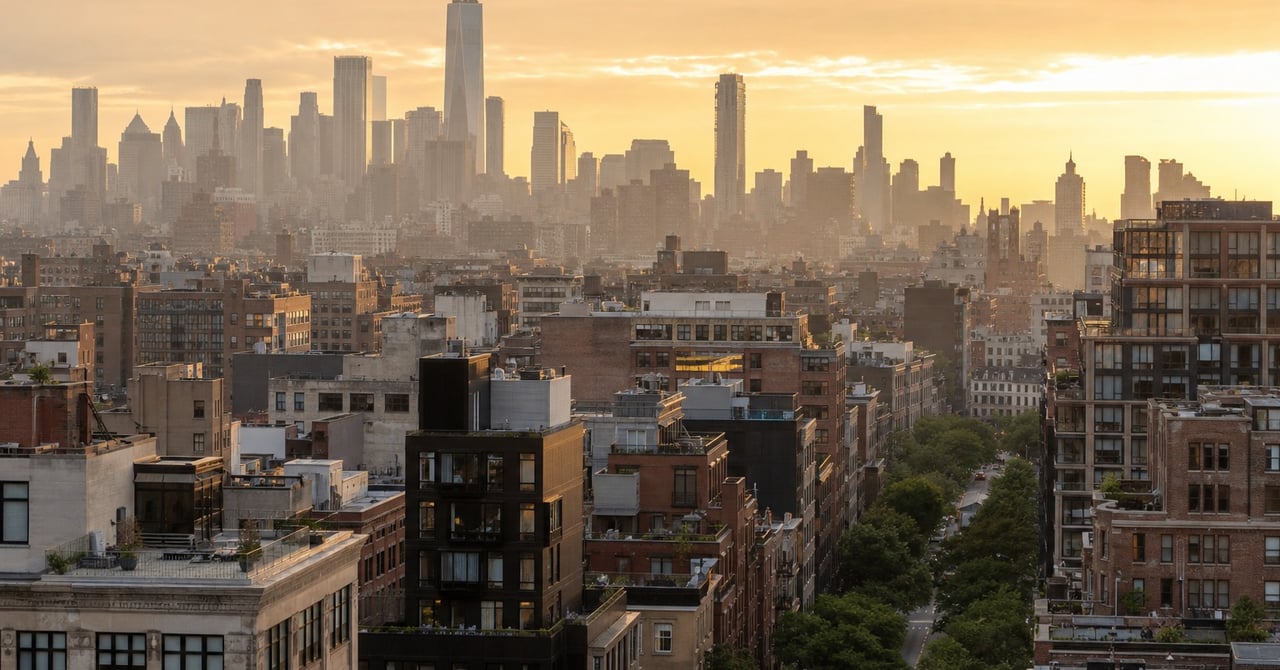
Walk 9th Avenue on a Tuesday night in late August and the block between 44th and 45th still smells like grilled lamb. As W42ST reported, Turkish Cuisine has been slinging lamb chops from that same stretch since 1996, and on August 5 the family that runs it quietly marked 30 years in a neighborhood where restaurants on that same block have opened and closed around them more times than anyone bothers to count. A few blocks south and one avenue over, the escalator under a brand-new 32-story tower now leads down to an ALDI, the discount grocer's first store in central Manhattan, open since June 19. And on the far side of the neighborhood, past 10th Avenue where the West Side Highway traffic drowns out the avenue noise, Larry Flynt's Hustler Club is packing up after two decades to make room for Peppermint Hippo, a national chain opening its first New York location in the same building, as W42ST reported.
Three stories. Three blocks. None of them selling. All of them, read together, telling you something about how this neighborhood actually works that you won't get from a single one on its own.
The pattern nobody's naming
The easy story about Hell's Kitchen is the one where old dive bars become juice bars, where a rent-controlled diner becomes a coworking space, where the neighborhood's character gets replaced by someone else's idea of what Midtown West should look like. That story is real in plenty of New York neighborhoods. It is not, as it turns out, what's actually happening on the ground here this year.
Look at what left and what arrived in each case. A grocery gap became a grocery store. A restaurant that's been open three decades is still open. An adult entertainment venue closed and was immediately replaced by another adult entertainment venue. Nobody flipped a category. The neighborhood isn't trading one kind of business for a fundamentally different one. It's recirculating ownership within the categories that were already there.
Here's what actually turned over, side by side:
| What left | What arrived | Where | What stayed the same |
|---|---|---|---|
| A retail gap beneath a new luxury tower | ALDI, first central Manhattan location | 311 West 42nd Street | Nothing left, but the category (grocery) matched neighborhood demand, not the building's price point |
| Nothing, it just hit a milestone | Turkish Cuisine's 30th anniversary | 9th Avenue between W44th and W45th | The restaurant itself, unchanged, on a block known for turnover |
| Larry Flynt's Hustler Club, 20+ years | Peppermint Hippo, first NY location | 639-641 West 51st Street | The use: adult entertainment, near the West Side Highway |
That middle column looks like disruption. Read against the third column, it looks more like continuity wearing a new name.
What the tower's basement tells you about who actually lives here
The Ellery is exactly the kind of building people point to when they want to talk about Hell's Kitchen going upscale: 32 stories, 330 units, a rooftop pool, coworking space, designed by Handel Architects. If you assumed the ground-floor retail would follow the building's price point, you'd expect a Whole Foods, an Erewhon, something with a juice bar built in.
Instead, ALDI signed a 25,000-square-foot lease there and opened its doors this June as the chain's first-ever central Manhattan location. According to W42ST, ALDI's regional vice president, Chris Daniels, called it a chance to bring affordable groceries to "the most in-demand locations across the country." That's a company talking point, but the retail math behind it is the actual story. A developer with a 32-story luxury tower to fill didn't chase a premium grocery tenant. It chased the tenant that would actually pull foot traffic from the surrounding blocks, where Hell's Kitchen's mix of longtime renters, service workers, and Theater District commuters has never been uniformly high-income no matter how many new towers go up around them.
That's worth sitting with if you already live here. The building next to you might be new and expensive. The businesses moving into it are still being priced for the neighborhood that exists on the sidewalk, not the one implied by the amenities deck.
The stretch that keeps not turning over
A few blocks away, 9th Avenue has a reputation, one that even the neighborhood's own local coverage leans on: restaurants come and go there constantly. It's the same stretch that hosts the Ninth Avenue International Food Festival every May, a street fair old enough that its 2026 edition was its 51st, and the churn on that block between festivals is real. Storefronts change hands. Menus rotate. What doesn't happen often is a restaurant lasting three decades on it.
Turkish Cuisine has. The family-run spot between West 44th and West 45th hit its 30th anniversary this August, a run that outlasted COVID, outlasted whatever opened and closed on either side of it, and did it without chasing trends. It's not an outlier because it's exceptional food, though the lamb chops have their following. It's an outlier because everything around it is designed to prove that longevity on that block is hard, and it did it anyway.
If you live near 9th Avenue, that's a small, useful thing to know: the neighborhood's most visible commercial corridor is more volatile than most, which makes the businesses that survive there more reliable, not less, precisely because survival on that block is a real test.
The far West Side keeps its own logic
Then there's the stretch past 10th Avenue, where the neighborhood runs up against the West Side Highway and Hudson River Park. This part of Hell's Kitchen has never looked like 9th Avenue's restaurant row or 42nd Street's tower corridor. Its history is industrial: tanneries and meatpacking plants in the 19th century, longshoremen's docks after World War II, and for the last two decades, a stretch that's held onto adult entertainment as one of its more visible uses even as the rest of the neighborhood built up around it.
Larry Flynt's Hustler Club has been part of that stretch for more than 20 years at 639-641 West 51st Street, a run that included a Banksy mural on the building at one point and enough foot traffic that Jon Stewart once gave it free publicity on television. This summer, the club's operator confirmed it's leaving. Taking its place: Peppermint Hippo, a fast-growing national gentlemen's club chain, opening its first New York location in the same building. The new operator, Alan Chang, has already gone before Manhattan Community Board 4's Business Licenses and Permits Committee to apply for the liquor license the space will need.
This isn't the neighborhood losing an adult entertainment venue to condos or offices. It's one operator handing the keys to another, in the same use, on the same block, in the part of Hell's Kitchen that has held that particular category longer than most of the towers around it have existed. The far West Side isn't following 9th Avenue's rules or 42nd Street's. It's following its own, and this summer's turnover proves it's still doing that.
What this actually means if you live here
Put the three side by side and the shape of the summer isn't gentrification in the sense most people mean it. It's not old character getting replaced by new money. It's three separate corridors, each replacing itself in its own image: the tower corridor gets budget retail because that's what the surrounding density actually wants, the restaurant row proves its volatility by making the exceptions to it notable, and the far West Side keeps its adult entertainment use even as the operator changes.
If you've been reading the neighborhood as one story of upscale arrival, this summer is a good reason to split it into three. The block you live near probably belongs to one of these patterns more than the others, and knowing which one tells you more about what's coming next than any single headline about a new tower or a closed storefront ever will.
If you're curious how these shifts in Hell's Kitchen actually show up in what a co-op or condo is worth on your specific block, that's the kind of read Heather Sells NYC does for a living. Schedule a complimentary market consultation whenever you're ready to talk specifics.